Selecting car parts using the VIN number
VIN (Vehicle Identification Number) – is a unique 17-digit code that contains information about the vehicle manufacturer and main specifications. It may include numbers and Latin letters, apart from I, O, and Q, which are forbidden because they are easily confused with the numbers 1 and 0.
The VIN contains detailed information about the vehicle, allowing you to quickly find the parts you need. Car part manufacturers take this data into account when creating catalogues so that you can select parts for a particular car as accurately as possible.
Selecting car parts using OEM number
The OEM or Original Equipment Manufacturer number is a unique number of the part containing letters and digits provided by the vehicle manufacturer. Car manufacturers use them to mark every part inside their cars. A non-original car part carrying an OEM number demonstrates that the part meets stringent car manufacturer standards and its parameters and technical specifications are identical to original equipment.
If the OEM number of the part that was originally installed in your car matches the OEM number of the product you are buying – it will fit your car.
Enter the part's OEM number in the search bar and click the "Search" button. 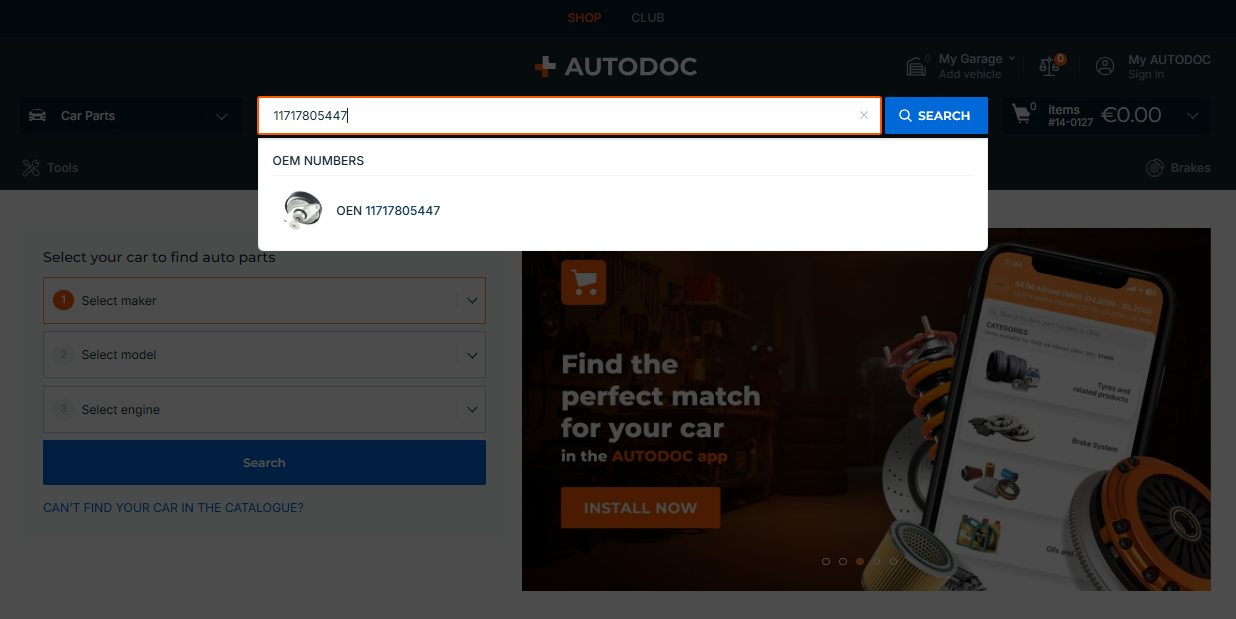
The OEM number is also displayed under the article number and in the "OE number" tab (in the product description).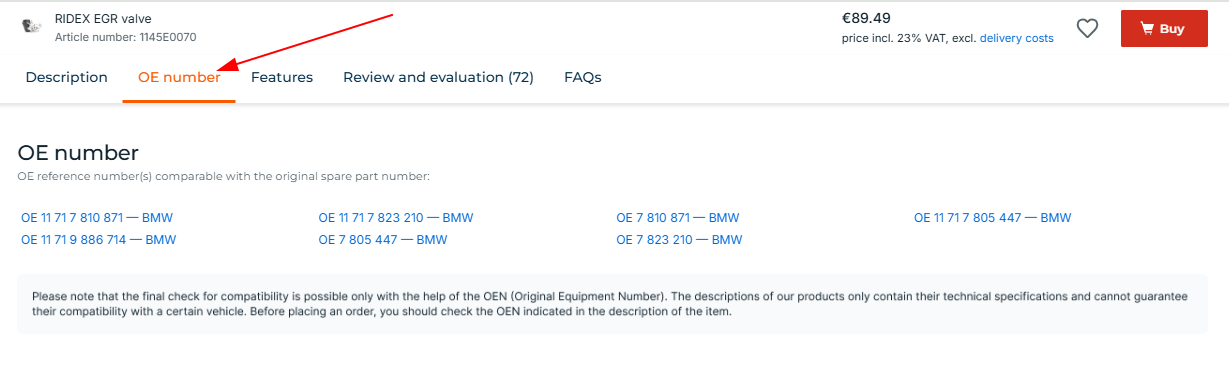
Selecting universal products
When selecting car accessories and universal products, it is necessary to:
- check the sizes
- compare the parameters from the product description with the parameters of the car
- check whether the product is universal or intended for a specific car mode.
Parking sensor kits
When selecting a kit, carefully read through the description and specifications. Also make sure to check the OE number of the part.
Car mats
When choosing this accessory, pay attention to the material it’s made of. Mats can be universal or adapted. Universal ones fit all cars, but may not cover the floor surface fully. Adapted mats are made for specific vehicle models and makes. They cover the cabin floor fully, leaving no gaps. Some of these accessories may have rivets, clips, hooks, bushings, anti-slip spikes, and other components to ensure that mats are securely fixed to the floor. Please note that the edges can vary in height. The edge height usually ranges from 1 to 4 cm. This specification is listed in the product description on the website.
Wheel covers
These accessories are only suitable for cars fitted with regular steel wheels. They need to match the rim diameter in inches. When choosing a product, pay attention to its description. Important note: you must only use accessories that match your wheels' size and other specifications. Before fitting the covers, make sure that they are not deformed or substantially damaged. For models with a retaining ring, check the spring stiffness: the higher it is, the more secure the fit will be.
Tools
When selecting a tool, consider what you will need it for and what specifications you require. For example, the maximum weight and lifting height for a jack or the minimum and maximum torque for a torque wrench.
FAQ
How can I find the VIN?
The VIN is usually specified in the vehicle owner’s manual. Usually, you can also find it in all the documents related to buying and registering a vehicle. You can also find the VIN on the vehicle itself, stamped on the chassis or on special plates.
Depending on the country of manufacture, you may find the VIN:
- on the windscreen;
- on the driver side door jamb;
- on door sills;
- under the bonnet;
- under the driver or front passenger side floor trim;
- stamped on the chassis.
The manufacturers repeat this number in several places for better fraud protection. All the VINs you find on your vehicle should be the same and should match those specified in the vehicle documentation.
Where can I find the OEM number?
You can find the OEM number on all vehicle parts. However, keep in mind that it may be difficult to see if the part is installed in a hard-to-reach location, damaged, or dirty.
If you want to use the OEM part number when purchasing a new part, it is best to dismantle the part so that the number can be correctly identified.
To make sure the part you choose fits your vehicle, please contact our experts via chat.
Does the search result on the website guarantee the compatibility of the part with my vehicle?
If you have followed our advice and checked the product description carefully, your part search should be successful. However, searching on the website does not guarantee absolute compatibility with your vehicle. The required part may be manufactured in several configurations, which means that there is a chance that the purchased part will differ from the one installed in your car.
To make sure the part you choose fits your vehicle, please contact our experts via chat.